
CHANCES Instrument Overview

CHANCES (Colour High-resolution Apophis Narrow-angle CamEra System) is, as its name suggests, a camera system designed to capture high-resolution colour images of the asteroid Apophis. ESA selected the Bernese instrument as a "payload of opportunity" for RAMSES in April 2025, to characterize the shape, scrutinize the surface of the asteroid and to detect possible subtle changes before, during and after its close-encounter with Earth.
The compact, lightweight yet powerful CHANCES camera system combines earlier developments from the University of Bern—such as CoCA, the main camera of ESA's Comet Interceptor mission, the Bernese Mars Camera CaSSIS, which has been providing high-resolution images of the surface of the Red Planet since 2018 or the space telescopes CHEOPS and PLATO —with innovative aspects that are tailored to the specific objectives of the mission, ideally complementing RAMSES' baseline payload.


Capabilities
Instrument Capabilities
High-Resolution
CHANCES will be able to offer detailed high-resolution views of parts of the asteroid's surface with a Ground Sampling Distance (GSD) of 6cm/px from a distance of 5 km or 1.2cm/px from a distance of 1 km. It ideally complements other imagers on board such as the Asteroid Framing Camera (AFC), which have broader fields of view to capture the entire asteroid but at lower resolution.
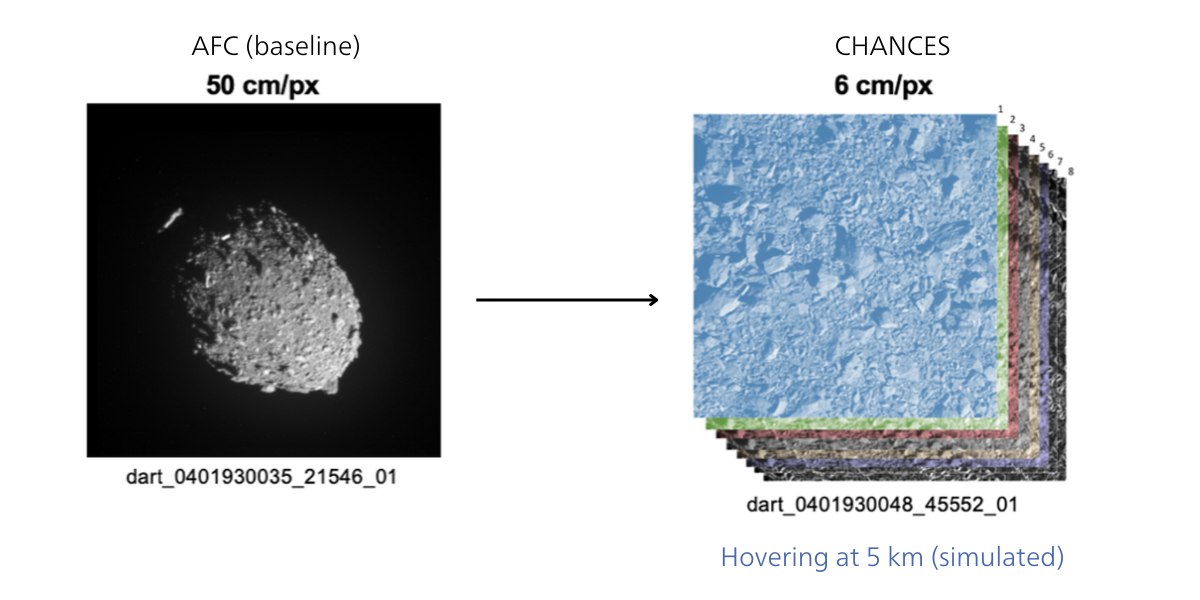
Refocusing
The instrument has refocusing capabilities for very short range sharp imaging. Varying distances are indeed a challenge for long-focal length narrow-angle cameras (NAC). CHANCES implements refocusing capabilities through bandpass filters of different thicknesses. Three colour filters will allow for 1.5 cm/px from 1.2 km. A single panchromatic filter will provide sharp images at even closer distances to reach ground sampling distance below 1cm/px toward the end of the mission.
Multispectral
CHANCES has multispectral capabilities at visible range (Vis) and short-wavelength infrared (SWIR). Its wavelength range is 400 - 1700 nn covered in 6 broad bandpasses.
Polarisation Sensing
By analysing how the sunglight is scattered and polarised by regolith particles over a range of phase angles, polarimetry can reveal variations in regolith properties and composition that are not easily detected through traditional spectral imaging alone, including surface porosity. For this reason, CHANCES is equipped with two crossed linear polarisers.
Very High SNR & Dynamic Range
CHANCES images will reach a high signal-to-noise ratio (SN >200) in all bands over well-illuminated regions of the surface.